Geometry of Music
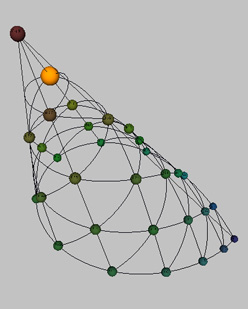
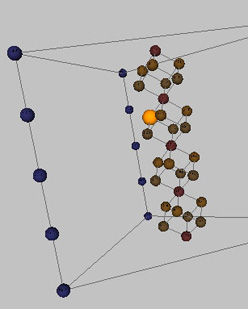
Composers often speak of fitting chords and melodies together, as though sounds were physical objects with geometric shape – and now a Princeton University musician has shown that advanced geometry actually does offer a tool for understanding musical structure.
In an attempt to answer age-old questions about how basic musical elements work together, Dmitri Tymoczko has journeyed far into the land of topology and non-Euclidean geometry, and has returned with a new – and comparatively simple – way of understanding how music is constructed. His findings have resulted in the first paper on music theory that the journal Science has printed in its 127-year history, and may provide an additional theoretical tool for composers searching for that elusive next chord.
“I’m not trying to tell people what style of music sounds good, or which composers to prefer,” said Tymoczko (pronounced tim-OSS-ko), a composer and music theorist who is an assistant professor of music at Princeton. “What I hope to do is provide a new way to represent the space of musical possibilities. If you like a particular chord, or group of notes, then I can show you how to find other, similar chords and link them together to form attractive melodies. These two principles – using attractive chords, and connecting their notes to form melodies – have been central to Western musical thought for almost a thousand years.” (…)
Tymoczko has released software (for Mac and PC) to create these visualizations yourself, as well as a number of demonstration videos.
ARTICLE (via robot wisdom) VIDEO [demonstration] LINK/VIDEOS [Tymoczko’s website and more videos] DOWNLOAD [ChordGeometries 1.1 software]
The piece used in the demonstration above is the fourth of Chopin’s 24 Preludes (Op. 28). Here is a full recording, as well as a link to a rendition sung by the Swingle Singers which I’ve posted about before.
AUDIO[Frederick Chopin - Prelude in E minor] AUDIO[Swingle Singers rendition]
Expanding the sensory range of music is something I like to think about. A friend of mine once wanted a graphic representation of the circle of fifths as a tattoo, and eventually I came up with the following, though motivation for the tattoo had since passed. The center bit shows the progression of key signatures. It’s definitely a rough draft, but the idea is there:
IMAGE [circle of fifths representation]
Previously on CN: Touching Music // [V-scratch]([link]) // Whitney Music Box