Van Gogh Knew Turbulence
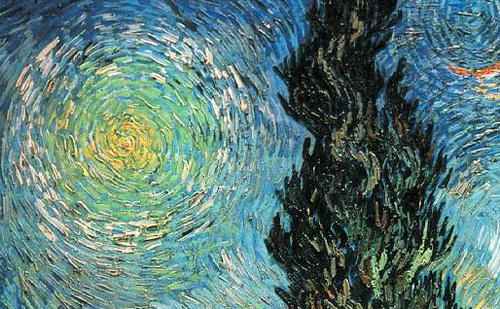
detail of Road with Cypress and Star (Artchive)

Vincent van Gogh is known for his chaotic paintings and similarly tumultuous state of mind. Now a mathematical analysis of his works reveals that the stormy patterns in many of his paintings are uncannily like real turbulence, as seen in swirling water or the air from a jet engine.
Physicist Jose Luis Aragon of the National Autonomous University of Mexico in Queretaro and his co-workers have found that the Dutch artist’s works have a pattern of light and dark that closely follows the deep mathematical structure of turbulent flow.
The swirling skies of The Starry Night, painted in 1889, Road with Cypress and Star (1890) and Wheat Field with Crows (1890) — one of the van Gogh’s last pictures before he shot himself at the age of 37 — all contain the characteristic statistical imprint of turbulence, say the researchers.
These works were created when van Gogh was mentally unstable: the artist is known to have experienced psychotic episodes in which he had hallucinations, minor fits and lapses of consciousness, perhaps indicating epilepsy.
“We think that van Gogh had a unique ability to depict turbulence in periods of prolonged psychotic agitation,” says Aragon.
In contrast, the Self-portrait with Pipe and Bandaged Ear (1888) shows no such signs of turbulence. Van Gogh said that he painted this image in a state of “absolute calm”, having been prescribed the drug potassium bromide following his famous self-mutilation.


