On Expansion and Scale
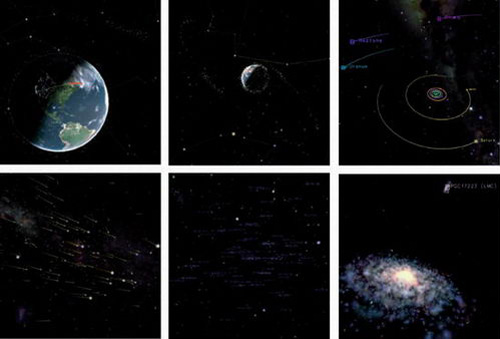
image: © 2006 IEEE
Some weekend foraging at PhysOrg:
Scientists Chi-Wing Fu and Andrew Hanson develop a model for visualizing the degrees of scale between different functional levels of matter formation, ranging from the observable universe as a whole to one Planck length. Inspired by the “Powers of Ten” video, their system provides for an efficient method of graphically rendering the universe from the smallest known regions to the largest.
Our motivation was to create a framework for a real-time digital planetarium. With this framework, we’ve created a series of layers of objects across an enormous scale range, all on a single screen.
Andrew Hanson
Basically I needed an excuse to post the following image with my annotations. Far be it for me to claim any kind of scientific credibility but the symmetry in the data below is, at the very least, fun to think about.
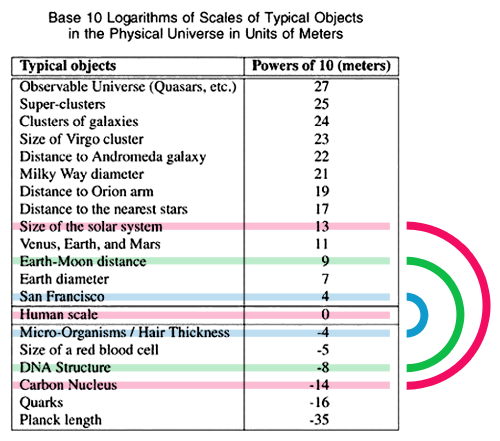
image: © 2006 IEEE, vandalized 2007 Justin Ruckman
I’m even less of a mathematician than I am a scientist, but if you pretend that some kind of functional standard deviation exists between the micro-organisms that compose a human body and the body itself, and conversely between the humans that compose a city and the city as a whole – you can continue in this scale outward/inward and see, at least for a while, a relative amount of physical and conceptual symmetry: the DNA molecules that compose an organism and the cities that compose a planetary system; the atoms that compose an organic molecule and the planets that compose a star system. Obviously if you go straight from the numbers the symmetry is a little less than perfect, but I’m not assuming that our cities, planets and organisms exist in the middle of any kind of universal average.
Anyway, something to think or not think about.
ARTICLE [“In ‘forty jumps,’ scientists model (…)] (PhysOrg)
image credit: cmiper
Two professors and a graduate student at UNC Chapel Hill formulate a new model that superimposes over the Big Bang theory, basically stating that instead of a universe expanding and contracting back into itself, it expands to a point where it is so far spread out that all the patches of matter finally snap loose and contract into themselves individually, creating a new generation of universes that upon their own contraction bounce back outward again, continuing the cycle of cosmic rebirth with a new generation of eager progeny.
I suddenly saw there was a new way of solving this seemingly impossible problem. I was sitting with my feet on my desk, half-asleep and puzzled, and I almost fell out of my chair when I realized there was a much, much simpler possibility.
Dr. Paul Frampton
Read the article and and paper for the math that allows all that to make sense. Satellites currently being built, including the ESA’s Planck satellite, will potentially contribute useful data to this and other similar theories.
ARTICLE ["No Big Bang? Endless Universe (…)] (PhysOrg) PAPER ["Turnaround in Cyclic Cosmology”] (Baum, Frampton)
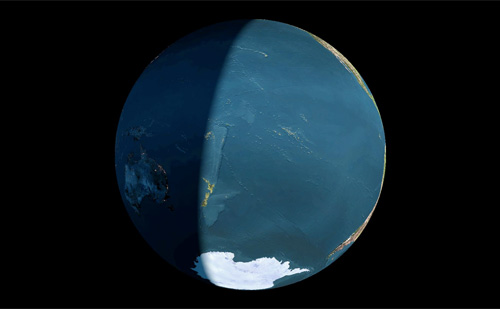
the Earth pretending to be an ocean planet, time of posting simulated via The Living Earth, © Earth Imaging
And finally, the recently launched CoRoT satellite, combined with ground-based observatories, will soon be able to estimate density of extrasolar planets, thus allowing us to locate long-theorized ocean planets, bodies of ice that fly close enough to their star to form a liquid outer layer, but not massive enough to have the gravity necessary to attract nearby hydrogen and helium, becoming gas giants.
ARTICLE [“Ocean Planets on the Bring of Detection”] (PhysOrg)