The Pirahã
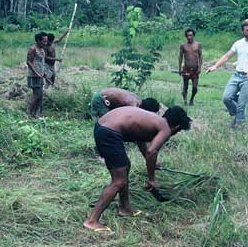
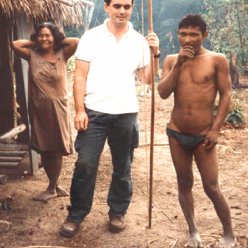

Unrelated to any other extant tongue, and based on just eight consonants and three vowels, Pirahã has one of the simplest sound systems known. Yet it possesses such a complex array of tones, stresses, and syllable lengths that its speakers can dispense with their vowels and consonants altogether and sing, hum, or whistle conversations. It is a language so confounding to non-natives that until Everett and his wife, Keren, arrived among the Pirahã, as Christian missionaries, in the nineteen-seventies, no outsider had succeeded in mastering it.
(…) The Pirahã, Everett wrote, have no numbers, no fixed color terms, no perfect tense, no deep memory, no tradition of art or drawing, and no words for “all,” “each,” “every,” “most,” or “few”—terms of quantification believed by some linguists to be among the common building blocks of human cognition. Everett’s most explosive claim, however, was that Pirahã displays no evidence of recursion, a linguistic operation that consists of inserting one phrase inside another of the same type, as when a speaker combines discrete thoughts (“the man is walking down the street,” “the man is wearing a top hat”) into a single sentence (“The man who is wearing a top hat is walking down the street”).
John Colapinto in “The Interpreter”, New Yorker (emphasis added)
ARTICLE [excerpt from “The Interpreter” (above)] (Edge) ARTICLE [“Living without Numbers or Time”] (Spiegel) ARTICLE [Pirahã people] (Wikipedia) ARTICLE [Pirahã language] (Wikipedia)